

Numerous climbing creatures in nature, including geckos, flies, spiders and beetles, are capable of crawling and clinging to vertical surfaces and even ceilings. This capability originates from aggregated van der Waals forces generated between the microstructures on their foot pads and substrate surfaces, which produce robust adhesion sufficient to sustain their body weight. Biological adhesion systems feature multi-hierarchical architectures, multiple adhesion mechanisms and cross-scale characteristics, delivering favorable mechanical properties such as low preload requirement and controllable adhesion & detachment.
Inspired by natural biological adhesion systems, diverse biomimetic adhesive materials have been developed worldwide. Benefiting from universal adaptability to various solid surfaces, reusability and tunable adhesion/detachment behaviors, these materials have attracted extensive research interest and been innovatively applied in wall-climbing robots, massive micro-transfer printing, dexterous robotic grasping, wearable electronics and other fields.
Biomimetic adhesive materials with bulb-tipped microstructures are representative architectures of complex morphological microarray configurations, occupying a vital position in the research of biomimetic interfacial mechanical materials. Exploration and innovation in their fabrication techniques have greatly advanced the development of biomimetic micro/nano manufacturing technologies. Especially with the progressive engineering application of biomimetic adhesion technology, research on scalable manufacturing processes is booming.
Among existing micro/nano array fabrication approaches, photolithography remains the dominant technique for fabricating such microstructures. Nevertheless, constrained by its inherent two-dimensional (2D) patterning nature via projection exposure, additional auxiliary procedures such as dip-coating and double-sided UV exposure are generally required to construct intricate three-dimensional (3D) geometries. These extra steps raise fabrication complexity and impose considerable limitations on structural design. Accordingly, developing novel fabrication strategies for complex 3D micro/nano structures bears great scientific significance and practical engineering value.
Recently, the research team led by Ji Keju, the company’s founder, proposed an innovative fabrication method for bulb-tipped biomimetic adhesive materials based on photolithography combined with thermal reflow. Leveraging the intrinsic physical properties of photoresist, thermal energy is applied to trigger structural deformation of the material, extending the conventional 2D photolithography patterning to quasi-3D microstructure fabrication. This approach offers a versatile route for manufacturing complex microarchitectures at the micro/nano scale.
Taking the fabrication of bulb-tipped biomimetic microstructures as the research object, the team realized tunable tip geometries by precisely regulating the thermal reflow temperature of photoresist. Combined with nanoimprint lithography or conventional molding processes, biomimetic adhesive materials with bulbous terminal structures can be facilely manufactured. The adhesion, friction, peeling performance and cyclic reusability of the resultant materials vary systematically with the geometric parameters of the bulb-tipped micropillars.
The fabricated bulb-tipped biomimetic adhesive material achieves a normal adhesion strength of 12.26 N/cm² on glass substrates, exceeding the shear adhesion force of gecko foot pads (10 N/cm²). Meanwhile, the material exhibits excellent cyclic durability. It possesses promising application prospects in damage-free adaptive adhesive handling by robotic manipulators and positional fixation of general objects.
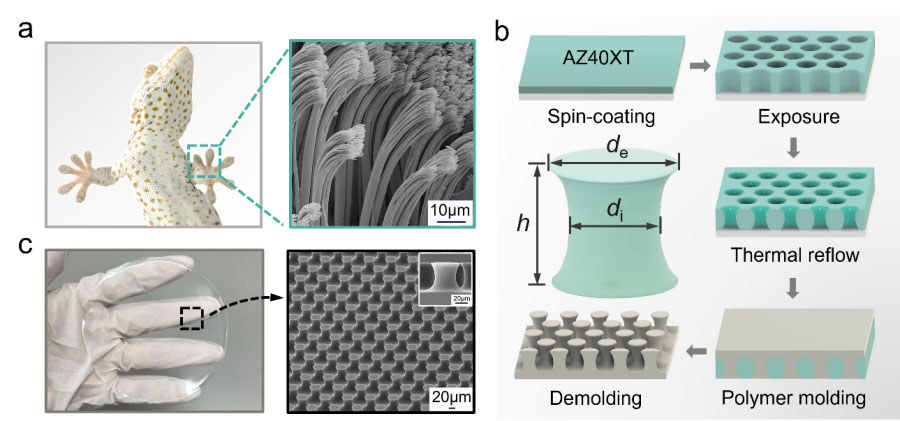
Figure 1: a) Photograph of a gecko climbing on glass and SEM images of setae on its toes; b) Schematic diagram illustrating the fabrication process of bulb-tipped biomimetic microstructures; c) Morphological graph of the bulb-tipped biomimetic microstructure array.
The photolithography-based thermal reflow fabrication process boasts remarkable advantages in the controllable preparation of bulb-tipped biomimetic microstructures. By precisely controlling the thermal reflow behavior of photoresist above its glass transition temperature, surface tension and interfacial tension drive material redistribution, which generates mushroom-shaped microstructures with circular cross-sections.
Specifically, within the temperature range of 110 °C to 130 °C, the polymer chains of photoresist acquire sufficient fluidity to trigger material migration. Coupled with Laplace pressure and interfacial tension, the photoresist forms a circular cross-section with minimized surface energy. After cooling, the polymer solidifies and maintains the preset shape, realizing accurate modulation of the geometric morphology of microstructures.
In addition, this process avoids material embrittlement and excessive crosslinking caused by ultrahigh temperatures, thus securing the structural stability and functional performance of microstructures. This fabrication technology provides an applicable engineering solution for the mass production of biomimetic microstructure arrays with complex morphologies.
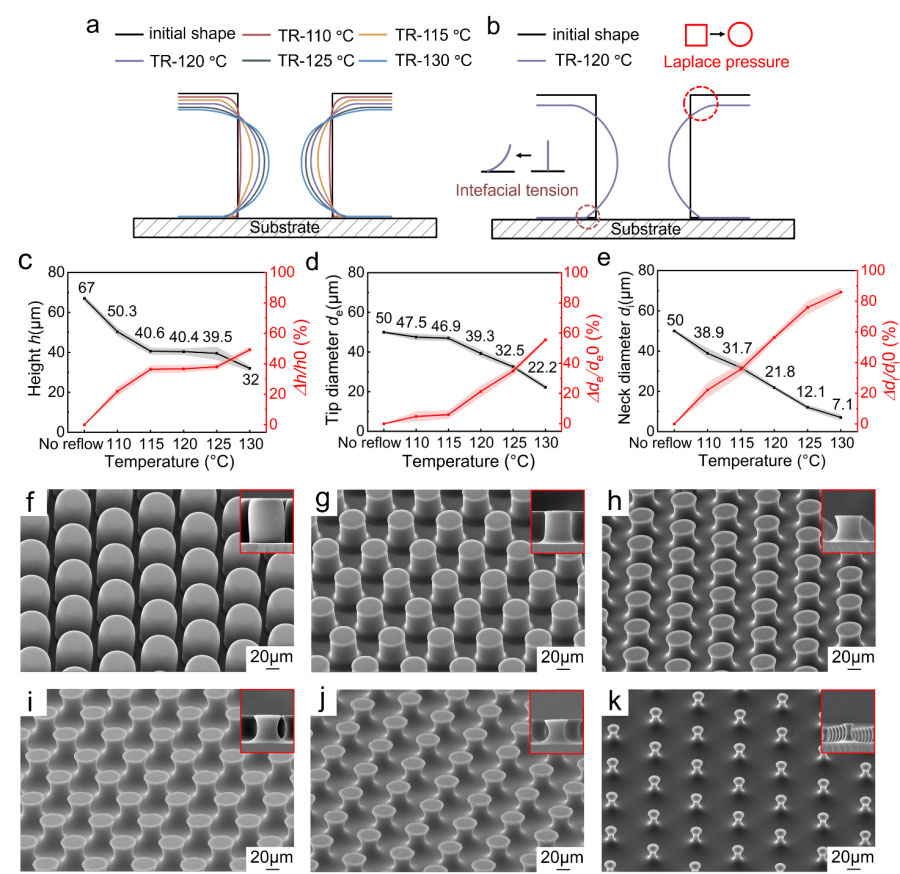
Figure 2: a) Variation of photolithography molds with thermal reflow temperature; b) Evolution process of the photolithography mold exemplified by the thermal reflow procedure at 120 °C; c–e) Heights of the microstructures; h) Variations of tip diameter ;d-e) and neck diamete;d-i) as a function of thermal reflow temperature; f–k) Microscopic morphologies of biomimetic microstructures fabricated under different thermal reflow conditions ((f) NTR; (g) TR-110°C; (h) TR-115°C; (i) TR-120°C; (j) TR-125°C; (k) TR-130°C)
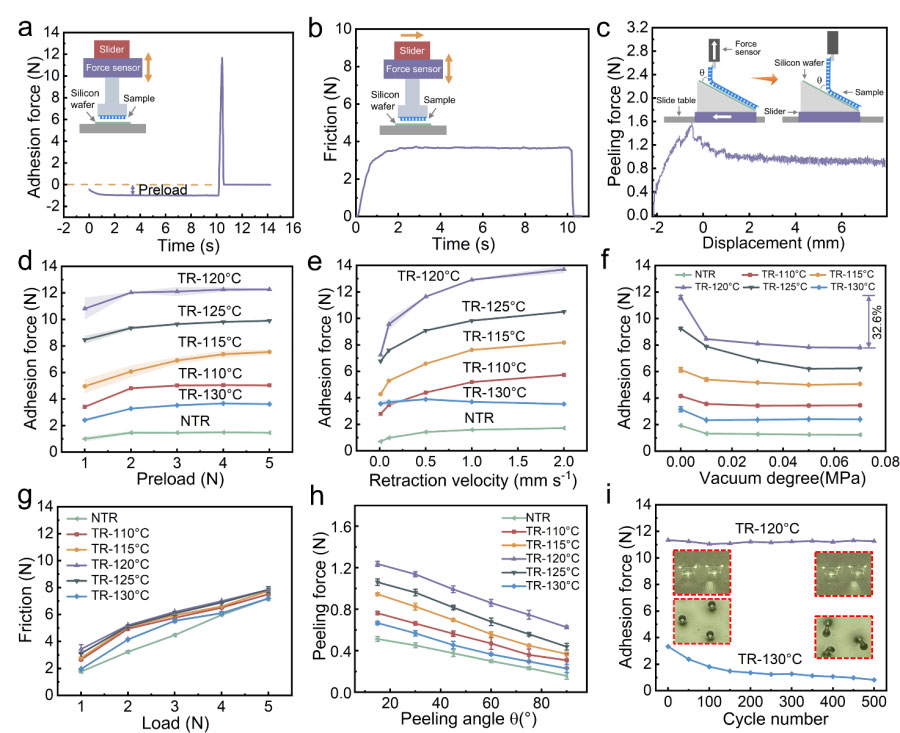
Figure 3: a–c) Schematic diagrams of testing experiments for adhesion force, friction force and peel force, together with corresponding force-time curves; d–h) Variations in normal adhesion force of bulb-tipped biomimetic adhesive materials under different preload pressures, detachment speeds, vacuum levels, preloading loads and peel/detachment angles; i) Reusability of adhesion performance for biomimetic adhesive materials fabricated via thermal reflow processes at 120 °C and 130 °C
This research represents one of our team’s latest advances in biomimetic interfacial mechanical materials. It proposes a fabrication strategy for biomimetic microstructure arrays with complex geometries, which can serve as a valuable reference for scaled-up engineering implementation.
Over the past three years, guided by the demands of aerospace and national defense sectors, our team has adopted a bionics research perspective and targeted the requirements of solid interface manipulation under harsh working conditions prevalent in general semiconductors and industrial automation. We have developed a complete portfolio of biomimetic surface and interface products, including:
· Bionic adhesive pads (Barcode: 6976093990006)
· Bionic friction pads (Barcode: 6976093990013)
· Physical suction cups (Barcode: 6976093990037)
· APR plates (Barcode: 6976093990020)
· Gecko adhesive tapes (Barcode: 6976093990044)
· Microneedle suction cups (Barcode: 6976093990051)
The fundamental findings and developed products have been deployed on China’s Mengtian Experimental Module as well as the Shenzhou-15, Shenzhou-16 and Shenzhou-17 manned space missions. These products are also mass-produced and supplied to leading enterprises across optoelectronics, semiconductor and automation industries, successfully tackling critical technical challenges of interface manipulation under vacuum, extreme temperature fluctuation, vibration and other harsh environments.
This work was financially supported by the National Natural Science Foundation of China (Grant Nos. 52075249, 62233008), the Space Medical Experiment Project of China Manned Space Program (Grant No. HYZHXM01009) and Tianyuan Laboratory Fund (Grant No. 24-JSKY-ZZKT-14). The authors gratefully acknowledge the above funding supports.
Paper Information:
Effect of Thermal Reflow on Microstructural Morphology and Contact Mechanics in the Photo-lithographic Fabrication of Biomimetic Adhesive Materials
Conghui Li, Jiahui Zhao, Jian Chen, Jun Sun, Zhiyong Hu, Yuanming Ji, Qianqian Li, Haozhen Zhan, Kai Deng, Jianming Wu, Zhendong Dai,* and Keju Ji*
Small Methods
DOI: 10.1002/smtd.202402123
Full-text URL:https://onlinelibrary.wiley.com/doi/10.1002/smtd.202402123