

Recently, Professor Tian Limei from the research group of Academician Ren Luquan at Jilin University published an extensive review entitled Bioinspired marine antifouling coatings: Status, prospects, and future (DOI:10.1016/j.pmatsci.2021.100889) online in the top materials journal Progress in Materials Science (IF=39.58). This full-length review covers approximately 52 pages, including 22 figures, 4 tables and 579 references. The paper systematically summarizes decades of research progress on bioinspired marine antifouling coatings, discusses existing application challenges, and prospects future development directions. Professor Tian Limei is the corresponding author, and Dr. Jin Huichao serves as the first author.
Marine biofouling refers to the phenomenon where fouling organisms such as bacteria, algae, barnacles and shellfish attach and grow on surfaces. Biofouling deteriorates hull surfaces, damages propellers, increases fluid resistance, and consequently leads to excessive fuel consumption and high maintenance costs. Statistics show that the United States Navy spends USD 1 billion annually to tackle biofouling issues. Globally, marine biofouling causes losses exceeding USD 15 billion to the marine industry every year. The history of human navigation is a continuous struggle against marine biofouling.
As early as 200 BC, toxic substances including asphalt, tar, copper, arsenic, sulfur and mercury were applied to hull surfaces to prevent marine biofouling. In the mid-20th century, a revolution took place in antifouling coating technology. Dutch scientist van der Kerk and colleagues discovered that tributyltin (TBT) possesses outstanding antifouling performance. As the most effective antifouling technology at that time, TBT coatings gained worldwide popularity and were widely adopted in numerous countries for decades.
Nevertheless, in the late 1970s and early 1980s, several rock oyster farmers in France reported abnormal deformation and developmental disorders in oysters. Subsequent research confirmed TBT as the root cause. TBT severely devastated oyster aquaculture industries in France, the United Kingdom and other nations. A series of follow-up studies revealed the adverse biological impacts of TBT. TBT residues have been detected in fish, birds, mammals and even humans. It is one of the most toxic anthropogenic substances introduced into the ocean. Traces of TBT can still be detected in various organisms to this day.
In 2001, the International Maritime Organization (IMO) assessed the adverse impacts of TBT on the marine environment. It stipulated a ban on the production of TBT-based antifouling paints starting from January 1, 2003, and prohibited the use of such coatings on ship surfaces from January 1, 2008.
Therefore, developing innovative environmentally friendly antifouling coatings has become an urgent demand for the marine industry.
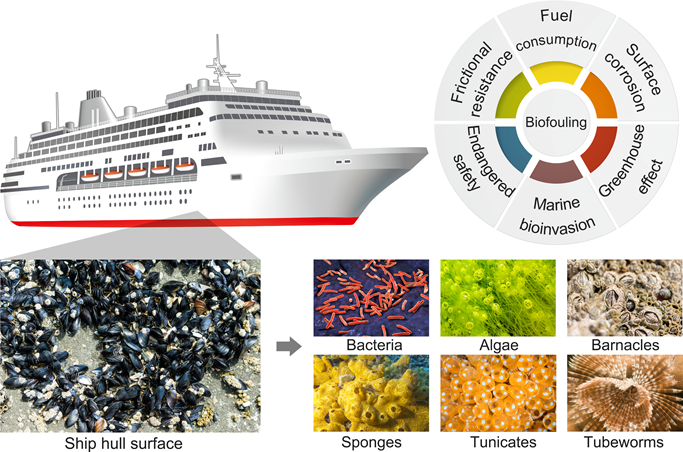
Figure 1 Marine biological fouling on hull surfaces and its adverse impacts
To relieve survival-related stresses, natural organisms have evolved outstanding antifouling capacities for bacterial-resistance infection and enhanced survivability. For instance, water films and contaminants on lotus-leaf surfaces hinder gas exchange and sunlight transmission. Its self-cleaning property thereby improves photosynthetic efficiency. These intriguing discoveries inspire researchers to develop high-performance, eco-friendly and cost-effective antifouling coatings. The publication quantity concerning bionic antifouling strategies has surged over the past two decades and attracted growing research interest, which promotes the progressive maturation of bio-inspired marine-antifouling technology.
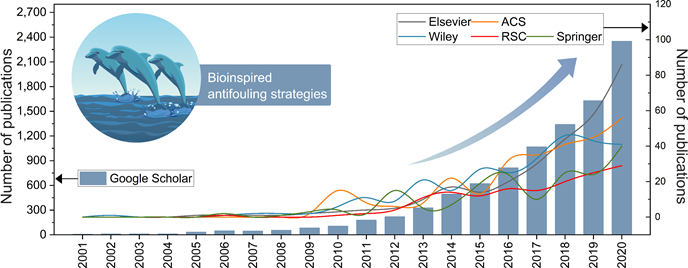
Figure 2 Annual growing publication output within the bionic antifouling research domain
This review summarises six mainstream bio inspired antifouling strategies: micro-nano textured surfaces, natural antifoulants, biomimetic hydrogels, slippery liquid-infused porous surfaces (SLIPS), dynamic bionic surfaces and zwitterionic coatings. (1) Micro-nano textured surfaces draw inspiration from lotus leaves, shark skins and rice-leaf epidermis. Micro-nanoscale textures lower the adhesive strength of fouling organisms and deliver antifouling performance. (2) Marine invertebrates, aquatic plants, microbes and certain terrestrial plants generate and secrete natural antibacterial metabolites that suppress fouling-organism attachment via multiple pathways. Extracting or artificially synthesising such active substances for coating fabrication constitutes an effective antifouling approach. (3) The mucus layers covering fish and frog epidermis represent native hydrogel materials. Their hydrophilic and compliant features confer favourable antifouling capacity. Hydrogel coatings replicating such traits form a vital research branch for marine fouling prevention. (4) Pitcher-plant-inspired slippery surfaces consist of porous substrates infused with lubricant liquid. Insects fail to gain stable foothold and slide down into the pitcher trap. Surfaces engineered based on this principle hinder the settlement of marine fouling organisms. (5) The compliant skin of dolphins deforms and vibrates under fluid flow to discourage biofouling attachment. Certain soft corals employ deformable soft epidermis or tentacles to minimise organism adhesion. (6) Phosphatidylcholine exists in eggs, soybeans, sunflower seeds and human cell-membrane components. Its head-group belongs to charge-balanced zwitterionic moieties with net electrical neutrality. Motivated by its blood-anticoagulant property, zwitterionic polymers have been developed as bio-inspired anti-adhesion materials and attracted rising research interest for marine antifouling deployment. This paper elaborates on the antifouling mechanism, fabrication protocols and critical practical challenges for every above-mentioned biomimetic antifouling tactic.
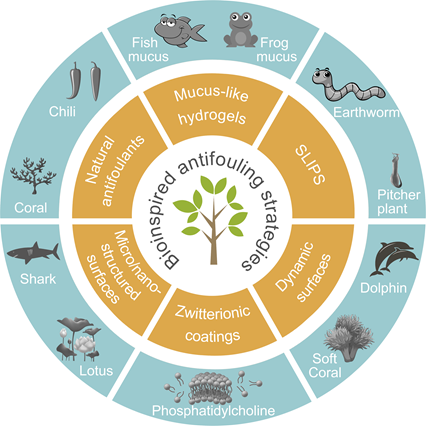
Figure 3 Six categories of antifouling strategies evolved by natural organisms
Biomimetic micro-nano textured surfaces are among the most-investigated branches of marine-antifouling research, supported by a broad portfolio of fabrication techniques, including deposition, template-assisted or soft lithography, etching, electrostatic processing, nanocomposite preparation, additive manufacturing (3D-printing), micromachining and self-assembly. This section compares the merits and drawbacks of these approaches. Numerous fabrication techniques suffer from high economic cost, poor scalability or environmentally-hazardous emissions during processing, which restricts their practical deployment. Environment-friendly, low-cost and mass-producible manufacturing techniques are therefore prioritised by marine-related industries.
Investigations into the correlation between micro-nanoscale geometric parameters (texture height, width, areal density and so forth) and fouling-organism attachment furnish essential guidelines for surface design and manufacturing. Antifouling-performance prediction models have evolved through several generations: the empirical qualitative contact-point model, the empirically-derived quantitative Engineering Roughness-Index (ERI) model, the semi-empirical surface-energy adhesion model combining the ERI and Monte-Carlo algorithm, and recently-developed purely-physical contact-mechanics-based models.
Nevertheless, existing models rely on simplified parameters to a certain extent. Real-world bio-attachment behaviour remains highly complicated and governed by multiple variables, such as organism species, temporal-spatial variation, flow velocity, surface topography and intrinsic substrate properties. Reliable prediction cannot be accomplished by a single influencing factor alone. Multivariate prediction frameworks will gain greater practical value for the rational design of antifouling coatings in future research. Furthermore, this review addresses bottlenecks hindering the real-world application of biomimetic micro-textured surfaces, including insufficient broad spectrum antifouling capability, easy loss of trapped air layers and unsatisfactory mechanical durability, alongside corresponding countermeasures developed so far.
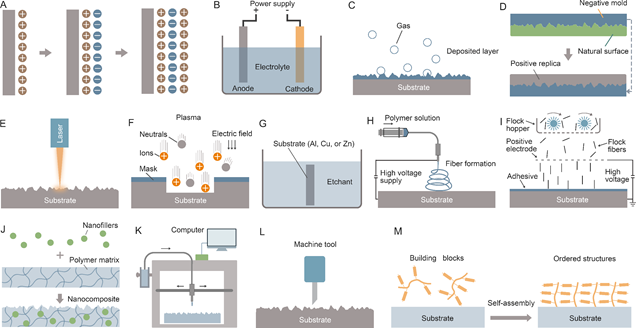
Figure 4 Advanced fabrication technologies for micro-nano antifouling surfaces
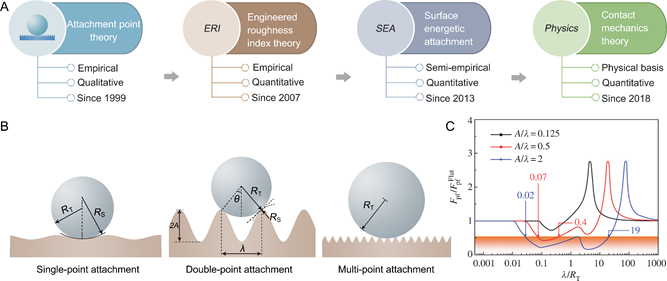
Figure 5 Evolution of prediction theories for the antifouling property of micro-nano surfaces
Conventional antifouling coatings inhibit marine biofouling by releasing toxic biocides. However, biocide leakage may induce bacterial drug-resistance, threaten marine ecological safety and suffer from uncontrollable release speed, which gradually weakens the long-term antifouling performance of coatings. Accordingly, the development of innovative eco-friendly and durable antifoulants is in urgent demand.
During biological evolution, creatures have evolved highly-efficient, broad-spectrum and long-lasting antifouling traits for survival adaptation. Natural antifoulants extracted from diverse organisms and their synthetic analogues have been extensively studied as promising alternatives. Guided by the principle “derived from nature, for nature”, hundreds of natural compounds have been isolated and characterised, with newly-identified natural antifoulants growing in quantity. Their chemical compositions and molecular architectures provide inspiration for designing marine antifouling coatings and medical antibacterial coatings. Nonetheless, high-priority environmental-safety assessment is indispensable for these natural antifoulants to prevent a recurrence of the tributyltin-related environmental disaster.
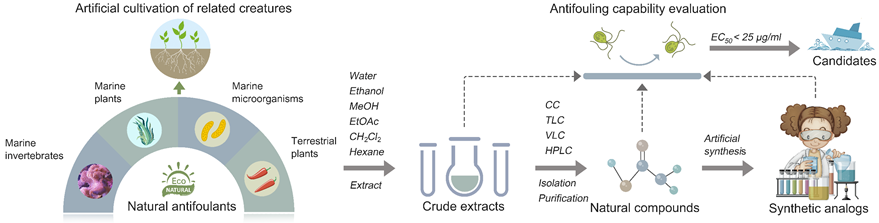
Figure 6 Development workflow of natural antifoulants
For practical engineering deployment, apart from biomimetic micro-nano textured surfaces and natural antifoulants, other antifouling schemes including biomimetic hydrogels, slippery liquid-infused surfaces, dynamic bionic surfaces and zwitterionic coatings still confront multiple technical obstacles. No universal antifouling strategy can maintain flawless performance under all marine conditions. Their comprehensive properties such as broad-spectrum antifouling capacity, service durability, mechanical strength and substrate-binding adhesion often become unsatisfactory within complicated seawater environments.
Previous biological investigations demonstrate that certain marine organisms evolve multiple coordinated antifouling mechanisms against fouling settlement. For instance, soft corals adopt four antifouling approaches: elastic epidermis, secreted natural antifoulants, oscillating tentacles and epidermal sloughing. Synergistic effects among these mechanisms endow corals with antibacterial, anti-attachment and pollutant-degrading capabilities.
Given the inherent limitations of single-mode antifouling tactics, developing multi-functional biomimetic antifouling coatings carries great research significance. Multi-synergistic antifouling systems integrate the strengths of diverse antifouling mechanisms, overcome the drawbacks of single-function strategies, greatly boost durability and fouling-resistant efficiency, and accommodate extended functionalities including noise reduction, drag reduction and self-healing. This paper summarises and analyses recently-reported composite-function coatings, intending to supply innovative insights for the advancement of biomimetic marine antifouling coatings. Prospects on the future evolution of bionic marine antifouling materials are presented in the final section.