

The advancement of sophisticated robotic grippers targets efficient, flexible and stable object manipulation via controllable adhesion and friction forces. For instance, flexible attachment pads delivering strong friction alongside weak adhesion enable reliable and high-speed wafer transportation. Insects equipped with smooth foot pads, such as cockroaches, locusts and katydids, are capable of highly dynamic attachment and detachment. Specifically, they generate robust friction and faint adhesion on their foot pads during high-speed movements including running and jumping. Accordingly, deciphering and replicating the friction-enhancing architectures of insect smooth foot pads can boost the development of climbing and grasping robots.
Recently, the research group led by Associate Researcher Ji Keju and Professor Dai Zhendong from the College of Mechanical and Electrical Engineering, Nanjing University of Aeronautics and Astronautics (NUAA), designed and fabricated a flexible bionic attachment mechanism that achieves strong friction and weak adhesion simultaneously under bionic principles. The design is inspired by the internal cuticle structure of smooth insect foot pads. For creatures, grasping and manipulating objects with limbs to interact efficiently with surroundings is vital to survival. After hundreds of millions of years of evolution, biological end-effectors including human hands, insect tarsi, octopus tentacles and cat paws have evolved diversified structures and functions to adapt to environmental challenges. Owing to their extraordinary locomotive capabilities, insects have become a key research subject in the field of bionic robotics.
The team verified that the outstanding adaptability, high friction and low adhesion of insect smooth foot pads stem from the combined effects of curved outer surfaces and internal dendritic frameworks, and optimal structural parameter ranges exist to maximize frictional performance. Based on bionic design theories, this study proposes a straightforward structural strategy for flexible attachments featuring enhanced friction and suppressed adhesion, offering innovative references for the design and fabrication of robotic grippers and adhesive units.
The research findings were published in Tribology International, a top-tier international journal specializing in tribology (SCI Q1 Journal, Impact Factor = 6.20), under the title: Insect-inspired design strategy for flexible attachments with strong frictional force and weak pull-off force. Zhao Jiahui, a doctoral candidate at the College of Mechanical and Electrical Engineering, NUAA, serves as the first author. Associate Researcher Ji Keju and Professor Dai Zhendong act as co-corresponding authors. This research was generously funded by the National Natural Science Foundation of China.
The bionic flexible pads developed in this study were fabricated via the rigid template method. The microArch® S140 photocuring 3D printer manufactured by BMF Precision (printing precision: 10 μm) was adopted for fabrication, and the schematic diagram of the manufacturing process is presented in Figure 1a.
The surface roughness, contact angle and Young’s modulus of the bionic flexible pads were characterized using a laser scanning confocal microscope, contact angle goniometer and universal tensile testing machine respectively (Figure 1b and 1c). Friction and adhesion performances were measured by the UMT-2 tribometer produced by Bruker, and the detailed testing procedures are illustrated in Figure 1d and 1e.
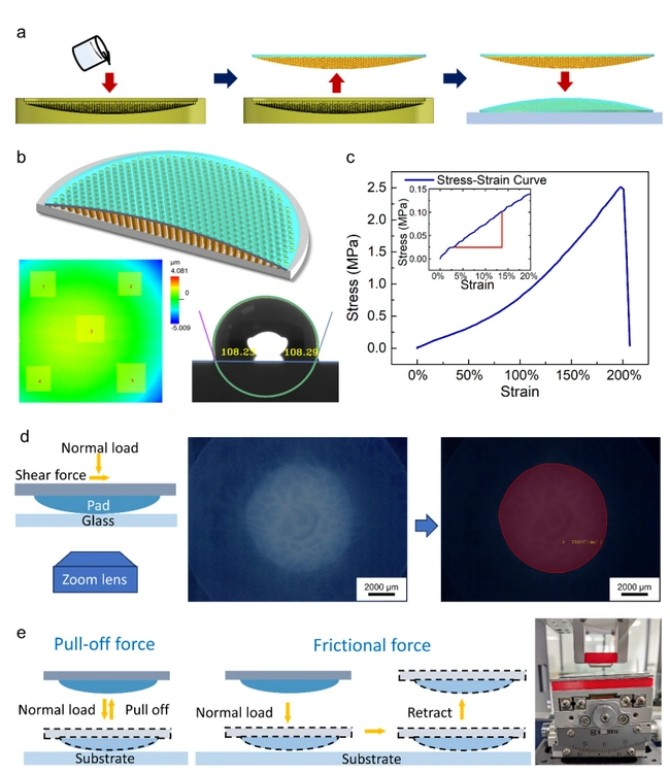
Figure 1 a) Schematic illustration of the fabrication process for bionic flexible pads via mold casting; b) Surface roughness and hydrophobicity of the bionic flexible pads; c) Stress-strain curve of commercial PDMS material; d) Total internal reflection image of frustrated light on the test bench; e) Schematic diagram of the friction measurement procedure adopted in this work and photograph of the testing platform.
Surfaces with diverse roughness values widely exist in nature, such as plant leaves, rock surfaces and tree bark. Insect foot pads can adapt excellently to these varied substrates and generate sufficient locomotion force accordingly (Figure 2a, d, g). The frictional pads of these insects consist of four hemispherical tarsal pads (Figure 2b, e, h), a structural feature commonly found in nearly all insect species with smooth foot pads, including crickets and stick insects.
Cross-sectional scanning electron microscope (SEM) images of the internal structure (Figure 2c, f, i) reveal that insects possess a smooth membranous cuticle with uniform thickness. Beneath this outer membrane layer, vertically aligned dendritic structures are evenly distributed throughout the interior.
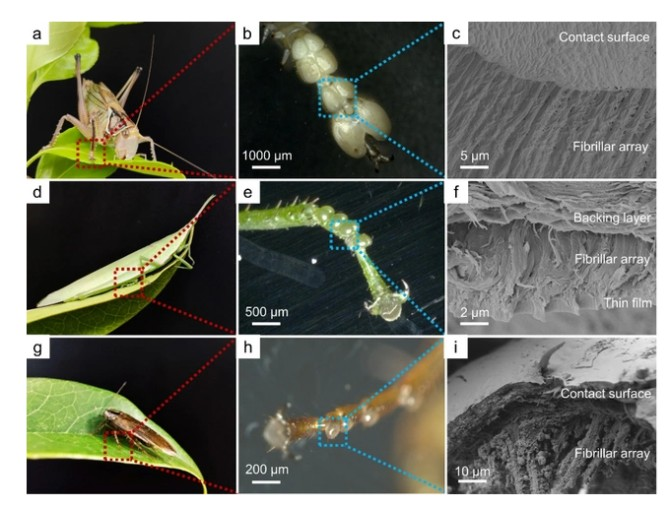
Figure 2 Foot pad structures of katydid, locust and cockroach a, d, g): Clinging and grasping postures of katydid, locust and cockroach; b, e, h): Ventral view of foot pads; c, f, i): Cross-section of the contact region of foot pads.
To clarify the influence of surface curvature on frictional behaviors, the team designed and fabricated three solid pads with curvatures of 0 m⁻¹, 10 m⁻¹ and 20 m⁻¹, designated as S0, S1 and S2 respectively. Frictional test results demonstrated that the increase in surface curvature improves the angular adaptability of the material and eliminates stick-slip failure. Nevertheless, for solid pads, rising surface curvature reduces the actual contact area, which drastically decreases friction force. The corresponding test results are presented in Figure 3.
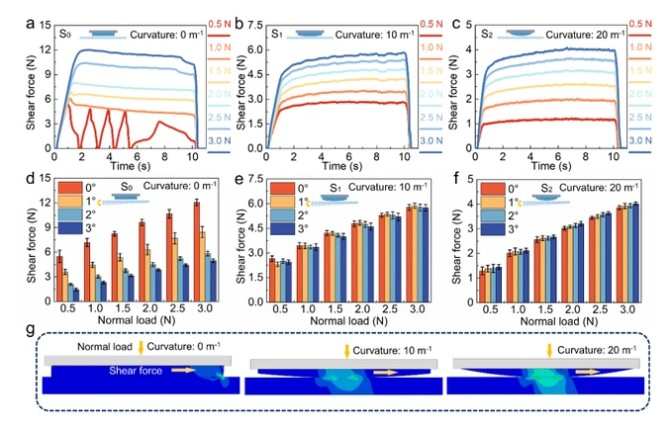
Figure 3 Friction tests of solid pads under various normal forces a–c) Force-time curves of solid pads with curvatures of 0 m⁻¹, 10 m⁻¹ and 20 m⁻¹ at a substrate inclination angle of 0°; d–f) Friction force of solid pads when the substrate is tilted at 0°, 1°, 2° and 3°; g) Finite element analysis of solid pads with different curvatures under applied loads.
Referring to the key internal structural features observed in the aforementioned scanning electron microscope images, the team designed and fabricated a bionic flexible pad with a diameter of 20 mm and a surface curvature of 20 m⁻¹ (Figure 4a). In this design, vertical pillars are arranged perpendicular to the curved contact membrane and anchored onto a flat rigid backing layer.
Four primary structural parameters dominate the frictional performance of the bionic flexible pad: pillar diameter (R1), center-to-center spacing between adjacent pillars (R2), maximum pillar height (L1), and contact membrane thickness (L2). Parameter analysis revealed that the frictional force is mainly governed by two dimensionless ratios: (R1/L2) and ((R1)2/(R2)2. For homogeneous flexible viscoelastic materials, these two ratios physically represent the vertical penetration depth and horizontal spreading width of stress propagating into the contact membrane, respectively. In this study, the optimized structural ratios determined for the selected material system are R1/L2 = 0.75 and(R1)2/(R2)2 = 0.36.
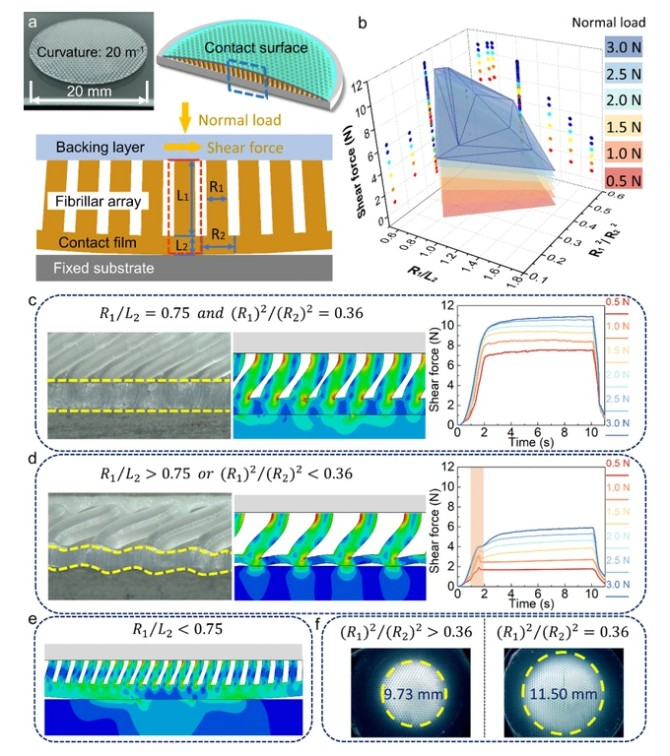
Figure 4 a) Photograph and schematic diagram of the bionic flexible pad; b) Shear force of the bionic flexible pad as a function of (R1/L2) and ((R1)2/(R2)2) under various normal forces; c–f) Dynamic experiments and numerical simulations analyzing the effects of (R1/L2) and ((R1)2/(R2)2) on friction force.
Eight substrates with distinct surface roughness values were selected to evaluate the surface adaptability of the bionic flexible pad (Figure 5a). The experimental results indicated that under relatively high normal loads ranging from 1.0 N to 3.0 N, the friction force on various substrates was predominantly determined by the material properties, while the influence of surface roughness could be neglected (Figure 5b).
By contrast, under a low normal load of 0.5 N, the friction force decreased remarkably with the rise of substrate surface roughness (Figure 5c), which originated from adhesion failure occurring on rough surfaces. Accordingly, once the surface roughness exceeded 0.408 μm, ploughing force became the dominant contributor to friction between the bionic flexible pad and the substrate.
Figure 5d demonstrates the practical application of the bionic flexible pad in vertical climbing and climbing at large tilt angles, verifying the broad application prospects of the high-friction material proposed in this work.

Figure 5 a) Eight substrates with varying surface roughness; b) Friction forces generated by the bionic flexible pad on the eight substrates under relatively high normal loads (1.0–3.0 N); c) Variation of friction force of the bionic flexible pad against surface roughness under low loads; d) Practical application of the bionic flexible pad array.
Conclusion Inspired by the internal structure of smooth insect foot pads, this study adopted 3D printing mold technology to fabricate bionic flexible pads suitable for mass production. The friction force and adhesion force of the pads are mainly affected by five parameters: pillar diameter, inter-pillar center distance, maximum pillar height, contact membrane thickness and surface curvature.
Accordingly, mechanical properties can be regulated by adjusting these parameters, so that the bionic flexible pads can maintain high friction force and easy detachability during rapid dynamic motions. Owing to their characteristics of strong friction and weak adhesion, the bionic flexible pads have promising application prospects in advanced manufacturing, such as aircraft inspection, gripping robots and semiconductor device fabrication.